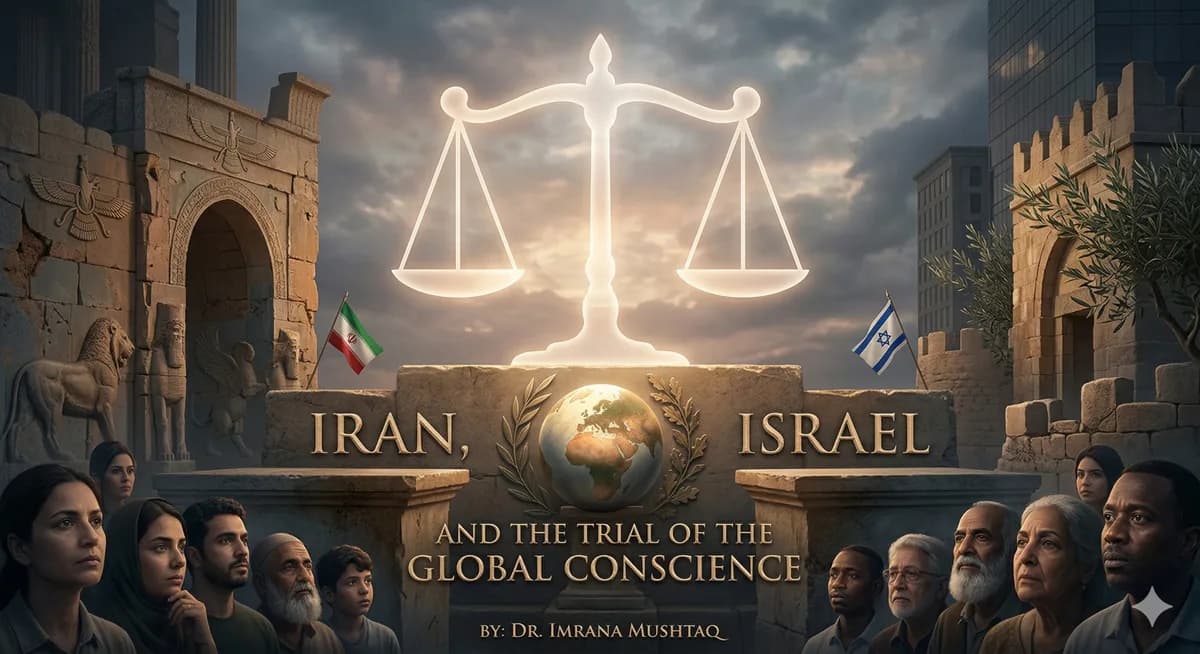
April 8 will be preserved in the pages of history as a new chapter—a chapter that future generations will not only read but also learn from. This day taught us that wars are not won merely with gunpowder, tanks, and missiles; rather, true victory belongs to the hearts burning with courage, conviction, patriotism, and national solidarity. Ostensibly, when a ceasefire occurs, the world views it merely as a treaty—a state where there is neither a clear victor nor an open loser. But the reality is far deeper. If a war stops on your terms, if the enemy is forced to change their strategy, that is actually a silent but true victory.
The recent situation in Iran has revived this reality once again. The nation that faced continuous sanctions, pressure, and threats demonstrated a level of perseverance and courage that astonished the world. When the enemy, in the arrogance of its power, thought it would bow the Iranian nation through fear, it did not realize it was clashing with a nation that has resistance running in its veins. The spirit with which the Iranian people faced the threats was not just a reaction, but an ideology, a faith.
It was an extraordinary scene when the locations targeted for potential attacks saw human chains forming instead of panic and terror. Instead of hiding out of fear of death, people stood holding each other's hands. This was not just bravery; it was a message that we are not a scattered nation, but a single entity. When nations exhibit this level of solidarity, no power can stand against them for long.
The question remains: where does this spirit come from? It is not merely a temporary reaction but the result of years of training, national consciousness, and a shared identity. When a nation begins to consider its ideology, its land, and its sovereignty as part of its own existence, it does not bow before fear. This is the state of mind that made the Iranian people an exemplar.
The history of wars repeatedly teaches us the same lesson: weapons alone are not decisive. If that were the case, the world's great powers would never face defeat. Vietnam, Afghanistan, and many other examples bear witness to the fact that when the people stand up for their homeland, even the most modern weaponry becomes meaningless. The true source of power is the resolve of the people, not a stockpile of weapons.
Another crucial aspect comes to the forefront here, and that is the role of leadership. The spirit of any nation only takes an organized form when it has a leadership that understands the circumstances, makes the right decisions, and gives confidence to the public. In the case of Iran, this element was prominently visible, where the people and the state appeared to be on the same page. This harmony is the actual strength of any nation.
Analyzing this incident in the context of Pakistan brings several important points to light. We are a nation passing through countless challenges—economic issues, political divisions, sectarian differences—but despite all this, there is a power within us that can unite us. Whenever Pakistan has faced a threat, this nation has put aside its differences and proven its unity. This is the spirit that needs to be kept alive on a permanent basis.
It is a fact hidden from no one that Pakistan's military and government have always played a vital role in difficult circumstances. In the recent situation as well, their role in preventing the spread of war, making diplomatic efforts, and taking steps to establish peace has been commendable. The peace points presented jointly by China and Pakistan are proof that there are still elements in the world that prioritize peace over war.
But the question is, will we learn anything from this occasion? Will we be able to end our internal divisions and become one nation? Will we be able to limit our differences so they do not harm our national solidarity? These are the questions we must answer ourselves.
Iran's example teaches us that nations are strong when they prioritize their shared interests over personal ones. True unity is only possible when every individual realizes that their identity is not limited to themselves alone, but that they are part of a larger unit. We too must adopt this mindset.
It is also a reality that war is never an ideal solution. Its consequences are always devastating, regardless of the party involved. However, sometimes wars are imposed, and in such cases, nations have no choice but to resist. True success lies not only in successfully defending yourself but also in sending a firm message to the enemy that you cannot be subjugated.
The day of April 8 has come before us with this very message. This day will continue to remind us that the true measure of power is not weapons, but human courage. This day will also keep telling us that if a nation unites, even the greatest threat cannot break its resolve.
For Pakistan, this is an opportunity to absorb this lesson. We must create unity within our ranks, correct our priorities, and instill within ourselves the confidence that is the hallmark of any strong nation. We must understand that our true asset is our people—their faith, their spirit, and their patriotism.
In the end, it can only be said that wars are won not on the battlefields, but in the hearts. If hearts are strong, no power can defeat you. And if hearts are weak, even the largest army cannot save you.
May Allah grant us the understanding to grasp this reality, act upon it, and become a nation that no power can bow down.