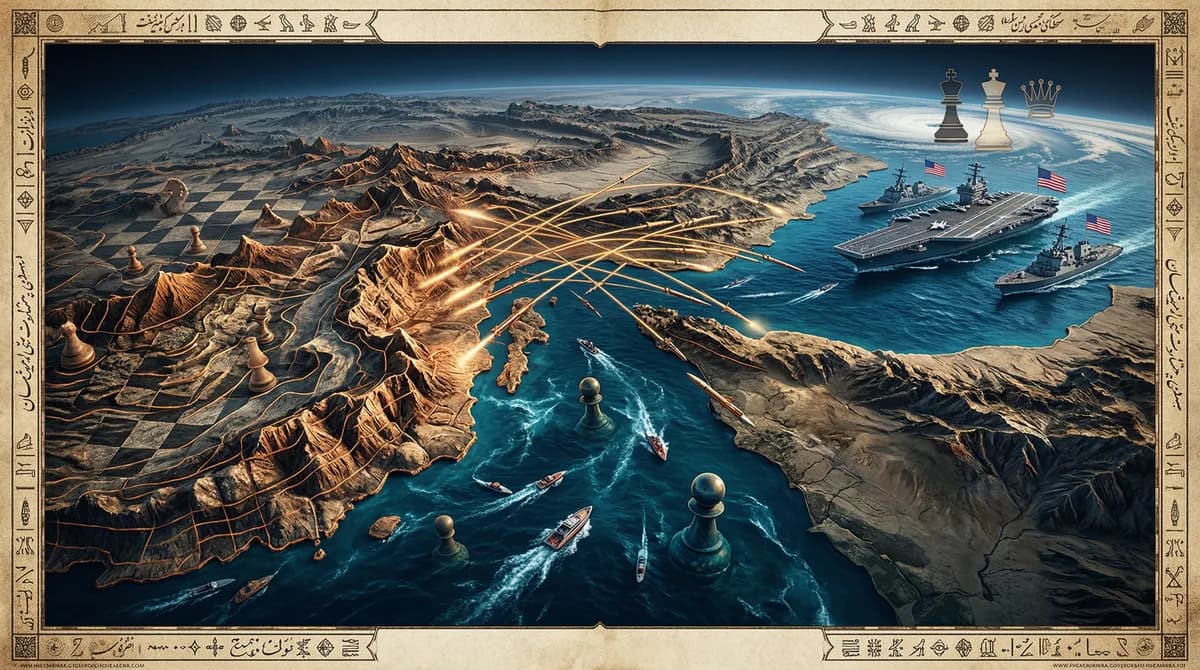
There are certain places on the world map where land, water, and politics intertwine so deeply that any ripple there affects the entire global order. The Strait of Hormuz is one such place. However, under current circumstances, its significance is no longer merely geographical; it has become a potential theater of war where the balance of power, the global economy, and regional politics are being put to the test.
The geography of the Strait of Hormuz tells a story of power in its own language. It is a narrow waterway connecting the Persian Gulf to the Gulf of Oman. To its north lies Iran's mountainous and relatively elevated coastline, while to its south are the relatively flat and highly developed shores of Oman and the United Arab Emirates. This very geographical structure provides Iran with a natural advantage—its coastal mountains, narrow waterways, and islands grant it a strong position both defensively and offensively.
Today, as the Middle East once again navigates through a climate of tension and war—whether it be the escalating friction between Iran and Israel, or the continuous presence of the United States in the region—the Strait of Hormuz has become a sensitive nerve center. Every passing naval vessel, every oil tanker, and every military movement feels like a harbinger of a broader conflict.
For Iran, the greatest strength of this strait lies in its geography, yet this same geography keeps it under perpetual pressure. Islands located near the strait, particularly Qeshm, Hormuz, and Abu Musa, serve as strategic outposts from which Iran can maintain not only surveillance but also military control. These islands enable Iran to restrict or disrupt the waterway in any potential combat scenario. Utilizing advanced missile systems, naval mines, and small, high-speed boats, Iran adopts a strategy of "asymmetric warfare," posing a formidable challenge to major naval powers.
However, this very power is also Iran's greatest vulnerability. In the current volatile atmosphere, where even a minor provocation can trigger a massive clash, the Strait of Hormuz could turn into a flashpoint at any moment. Should a mishap or limited skirmish occur here, its effects would immediately reflect in global oil prices, shipping routes, and financial markets. With roughly one-fifth of the world's oil passing through this corridor, it ceases to be a mere regional issue and transforms into a question of global stability.
The naval presence of the United States and its allies in the region is continuously expanding. Advanced warships, drones, and surveillance systems underscore the resolve of global powers to keep this waterway open at all costs. In response, Iran leverages its geographical superiority and local knowledge to establish a defensive perimeter that, while seemingly small, is highly complex and effective in practice.
Another crucial aspect comes into play here: topography. Iran's coastal regions are predominantly rugged and mountainous, providing it with natural defenses. These areas are not only ideal for concealing military installations but also make it exceedingly difficult for adversaries to target them. Conversely, the coastlines of the Gulf states are largely flat and heavily urbanized, rendering them economically robust but relatively less secure from a military standpoint. This geographical disparity becomes a pivotal factor in wartime strategy.
Amidst the current geopolitical climate, another shift is evident: the global transition towards alternative energy sources. Although the importance of oil has not yet diminished, the growing adoption of renewable energy in the future could impact the strategic significance of the Strait of Hormuz. Consequently, Gulf nations are heavily investing in pipelines and alternative transit routes to reduce their reliance on this critical chokepoint.
Nevertheless, despite these shifts, the reality remains that the Strait of Hormuz continues to play a central role in global politics today. Iran understands this perfectly and utilizes it as leverage in its policies. Whenever economic sanctions or diplomatic pressures mount against it, the mere reference to the Strait of Hormuz emerges as an unspoken message—a reminder to the world that geography cannot be ignored.
It is also worth noting that wars are not fought with weapons alone; geography, economy, and psychology act as crucial arsenals. Iran's presence in the Strait of Hormuz exerts psychological pressure, forcing global powers to remain cautious. This is exactly why, despite the looming possibility of an all-out war, a state of "controlled tension" is deliberately maintained in the region.
If we analyze this entire scenario from a broader perspective, it becomes clear that the Strait of Hormuz is not just a waterway, but a geographical destiny—a destiny that grants Iran power while simultaneously keeping it under trial. The current wartime conditions have further highlighted the reality that certain regions of the world will forever remain epicenters of conflict, simply because their geography itself gives birth to politics.
In conclusion, it can be said that the Strait of Hormuz is a place where the flow of power continues alongside the flow of water. The waves here do not merely belong to the sea, but to global politics, and it is upon these very waves that major decisions of the future are navigated. For Iran, this strait is not just a defensive fortress but a perpetual test—a test where success depends not solely on sheer power, but on wisdom, patience, and the right decisions.