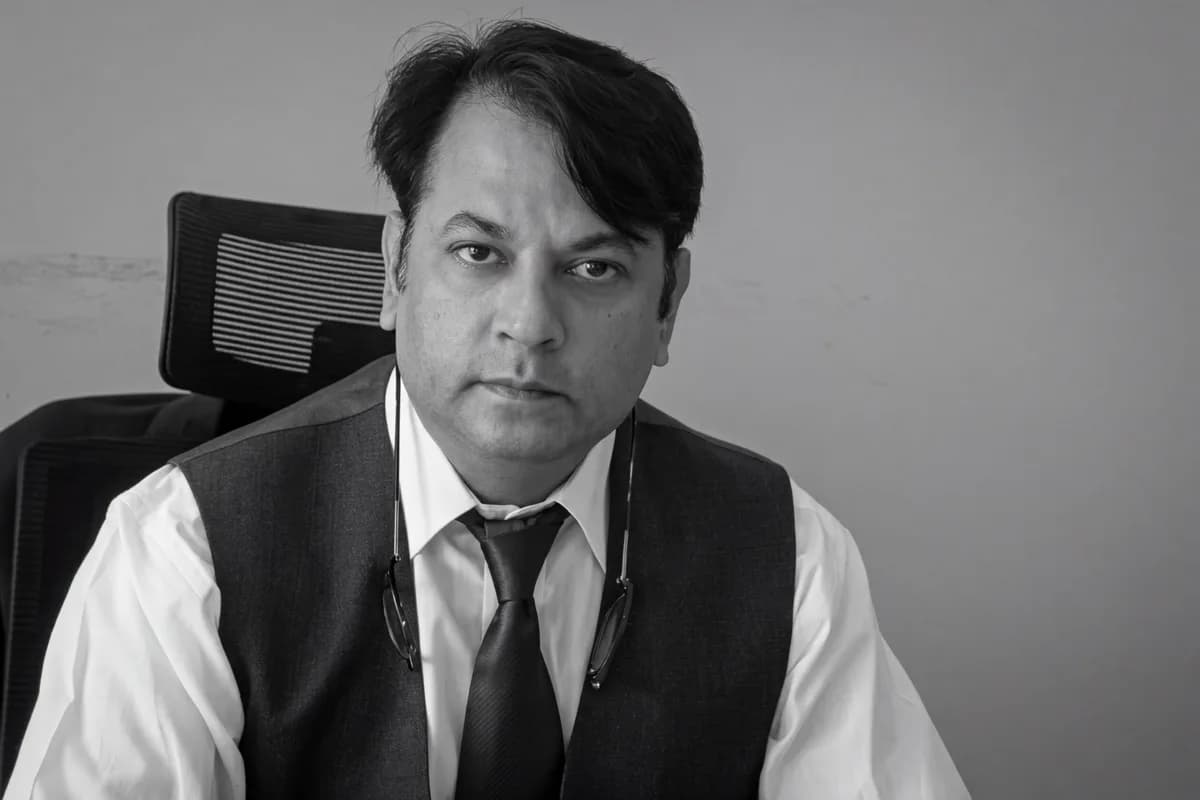
Muhammad Saleem Sagar’s poetry collection, “Main Kahani Mein Lapata Hua Tha” (I Got Lost in the Story), is not merely a collection of verses, but a mirror to the intellectual and emotional universe of a conscious mind, a sensitive heart, and an experienced personality, wherein many colors, layers, and voices of life resonate simultaneously. This book brings forth the creative dimensions of a poet who does not simply write while carried away by emotion, but endows words with meaning after tempering them in the fire of observation, experience, and awareness.
It would not be an exaggeration to say that the seriousness, composure, and intellectual insight of a mature human being are prominent in Saleem Sagar’s poetry. Despite being a civil servant by profession, the manner in which the subtlety of emotions, the softness of feeling, and the depth of thought manifest in his work refutes the general impression that official responsibilities dim the poet within. Rather, it feels as though his experiences have made his inner self even more fertile.
The most prominent quality of this poetry collection is its intellectual balance. Saleem Sagar neither resorts to emotional exaggeration nor burdens the reader with dry intellectualism. His tone is moderate, polite, and dignified, drawing the reader in and keeping them engaged until the very end. This precise balance grants his poetry a special dignity.
Thematically, his poetry encompasses a vastly wide spectrum. Love, the eternal subject of Urdu poetry, is present in his work as well, but with a new approach. This love does not appear as superficial or merely emotional, but as a deep, dignified, and intellectual state. In his work, love sometimes becomes an internal dialogue, sometimes a question, and sometimes an experience in which a person loses themselves only to find themselves again.
Similarly, the impermanence of life, the ruthless flow of time, and the anguish within the human soul are vital themes in his poetry. He expresses these subjects with immense simplicity yet deep impact. There is certainly a quiet sadness in his verses, but this sadness is not despair; rather, it is an awakened state of consciousness—a feeling that lingers in the reader's heart for a long time.
The book “Main Kahani Mein Lapata Hua Tha” holds a deep symbolic significance in its very title. This title is actually the intellectual foundation of the entire book. Here, the poet views life as a story—a story in which a person is sometimes a character, sometimes a narrator, and sometimes gets lost in search of themselves. This disappearance is essentially an inner journey, a process of self-discovery, which compels the reader to look within themselves as well.
Saleem Sagar’s ghazals carry both the fragrance of classical tradition and the restlessness of the modern era. While maintaining the traditional mold of the ghazal, he infuses it with new feelings, new symbols, and new intellectual dimensions. It is this synthesis that makes his poetry unique. His similes and metaphors are not only beautiful but also possess a semantic depth that doesn't just entertain readers but forces them to reflect.
An important aspect of his poetry is its existential state. Themes such as the search for identity, the fear of scattering with time, and the fragility of human relationships repeatedly emerge in his verses. He does not view loneliness merely as a sorrow but regards it as a creative and spiritual experience. This is why there is both pain, and meaning to that pain, in his poetry.
He also has a keen eye on societal attitudes, but instead of direct criticism, he conveys his message in a refined and gentle manner. His protest is not bitter but polite, sinking into the heart and making the reader think.
In terms of language and expression, Saleem Sagar's poetry is extremely simple, fluent, and captivating. Instead of difficult words or complex constructs, he uses language that converses directly with the heart. His choice of words feels very deliberate, creating a special musicality and beauty in his poetry.
Technically, his poetry clearly demonstrates maturity. The use of meter (behr), refrain (radeef), and rhyme (qafiya) is handled with great elegance, proving that the poet is fully aware not only of emotion but also of the rigorous requirements of his craft.
The mention of Lahore in his poetry comes with a special romantic and spiritual aura. In many of his verses, Lahore appears not just as a city, but as an emotion, a memory, and an internal affiliation.
Dil dharakta raha Madinay mein Jism Lahore mein basa hua tha Main ne chola pehan ke Bulleh ka Raqs Lahore mein kiya hua tha
(The heart kept beating in Madina / While the body resided in Lahore / Wearing the robe of Bulleh Shah / I had danced in Lahore)
These verses are not just an expression of love for the city, but also a symbol of cultural and spiritual connection. It feels as if, for the poet, Lahore is not a geographical location but an internal state.
Similarly, a beautiful blend of simplicity and meaning can be seen in his other verses:
Uss ki aankhon ka aik darwaza Mere dil ki taraf khula hua tha Jis ne chaha bura kisi ka Saleem Uss ka apna bohat bura hua tha
(A door of her eyes / Was left open towards my heart / Whoever wished ill upon someone, Saleem / Suffered a great deal of ill themselves)
These verses serve as proof that Saleem Sagar possesses the art of saying profound things in very few words.
Another prominent feature of the book is its beautiful printing and attractive presentation, which mesmerizes the reader not only in reading but also in its visual appeal. The beautiful blend of colors and imagery makes this poetic journey even more captivating.
Overall, “Main Kahani Mein Lapata Hua Tha” is a poetry collection that doesn't just offer the pleasure of verse, but takes the reader on an intellectual and emotional journey. This book is a beautiful synthesis of internal wandering, love, time, identity, and the existential questions of mankind.
In conclusion, it is fair to say that this effort by Saleem Sagar is a dignified addition to Urdu literature. It feels not just like a book, but the beginning of a continuum—a continuum from which more mature, deep, and impressive creations can be expected in the future.