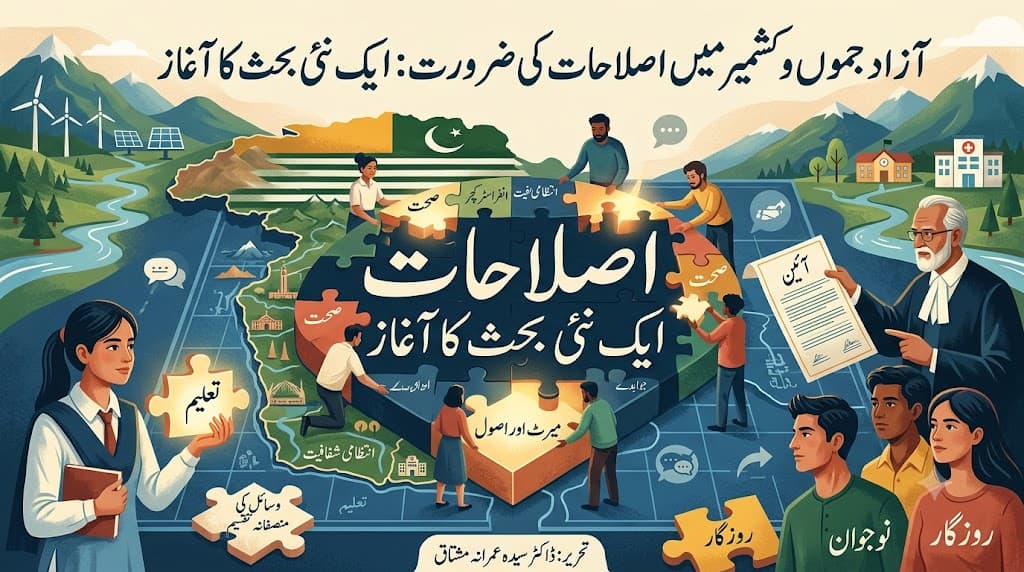
The beauty of democracy is that the constitution, law, and administrative structure are not considered static. In light of changing circumstances, the expectations of the new generation, administrative experiences, and public needs, the necessity for reforms is felt from time to time. In successful democracies around the world, the electoral system, local governments, judicial structures, government institutions, and methods of public representation are continuously reviewed. In this context, there is a need for a serious and academic discussion on the current political and administrative system of Azad Jammu and Kashmir.
It must remain clear that the purpose of reforms is not to weaken any particular class or group, but to make state institutions more effective, transparent, and accountable. A difference of opinion is the beauty of democracy, and constitutional changes only prove sustainable when achieved through broad political consensus and due legal processes.
The current political structure of Azad Jammu and Kashmir was formed several decades ago. During this time, significant changes have occurred in the region's population, society, education, economy, and political environment. This is why some experts believe that the formation of the assembly, the distribution of seats, and the principles of representation should be reconsidered. For this purpose, an impartial constitutional commission can be established to compile recommendations, keeping in view the census, population, administrative necessities, and constitutional requirements.
A part of this debate also relates to the reserved seats for the refugees of Jammu and Kashmir. Various opinions exist on this topic. One viewpoint argues that the current system has a historical and legal background and must be respected. The other viewpoint is that the method, number, and electoral process of this representation should be periodically reviewed to ensure it aligns with current ground realities and democratic principles. For any change of this nature, broad consultation, legal analysis, and national consensus are absolutely inevitable.
The issue of development funds has also been under discussion for a long time. In a democratic system, public resources should be utilized according to transparent principles. The need of the hour is that priorities for development projects should be determined based on population, backwardness, basic amenities, and developmental indicators, rather than political affiliations. If flaws exist in the current system of fund distribution, their correction should be carried out under uniform principles for everyone, so that public trust in the utilization of resources increases.
There is also a need for serious dialogue on the State Subject law and educational quotas. For some circles, the purpose of these laws is the protection of state identity and historical rights, while other circles support reforms so they can be reviewed according to contemporary circumstances. This is a sensitive constitutional and legal subject; therefore, any decision regarding it should only be made after complete legal consultation and incorporating the opinions of all relevant stakeholders.
The matter of appointments in government institutions also remains a topic of public interest. Whether it is the department of health, education, police, or any other sector, the strengthening of state institutions is only possible when appointments are transparent, merit-based, and follow clear rules. Public trust is established only when institutional decisions are based on principles rather than personalities.
Different opinions have also emerged regarding the oath and constitutional responsibilities of the members of the Legislative Assembly of Azad Jammu and Kashmir. In this regard, some circles maintain that the text of the oath or constitutional requirements can be reviewed periodically, while other circles are in favor of maintaining the current system. In such matters, it is necessary to consider the constitution, legal traditions, the international nature of the Kashmir issue, and the interpretations of the relevant courts.
Another important aspect of political reforms is the devolution of power to the grassroots level. Strong local bodies, an empowered district system, digital governance, e-government, online services, financial transparency, independent accountability institutions, and effective civic participation are the fundamental principles of modern governance. If Azad Jammu and Kashmir makes progress in these areas, it can increase both public trust and institutional performance.
The youth of Azad Kashmir desire employment, quality education, modern healthcare facilities, and transparent governance. For them, it is far more important that state institutions are effective, decisions are timely, investment flows in, tourism is promoted, water resources are utilized, and infrastructure is strong. These are the reforms that can directly exert a positive impact on the daily lives of the public.
Reforms do not just mean changing laws, but also changing mindsets. If a law exists but its implementation is weak, even the best constitutional structure cannot yield the desired results. Therefore, accountability, transparency, merit, rule of law, and institutional autonomy must be a fundamental part of any reform agenda.
Finally, it would be appropriate to say that Azad Jammu and Kashmir is a sensitive political region; therefore, every constitutional and administrative change here should be made with extreme responsibility, broad consultation, and through a democratic process. A difference of opinion must be considered a catalyst for betterment, not a source of enmity. The success of any proposal depends on whether it fully meets the principles of the constitution, law, justice, equality, and public interest.
If the purpose of reforms is to strengthen institutions, increase public trust, and establish better governance, then such a debate is highly welcome. However, every step must be taken within the strict framework of the law, constitutional requirements, human equality, and democratic principles. This is the only path that can lead Azad Jammu and Kashmir toward a stronger, more stable, and public-friendly system.