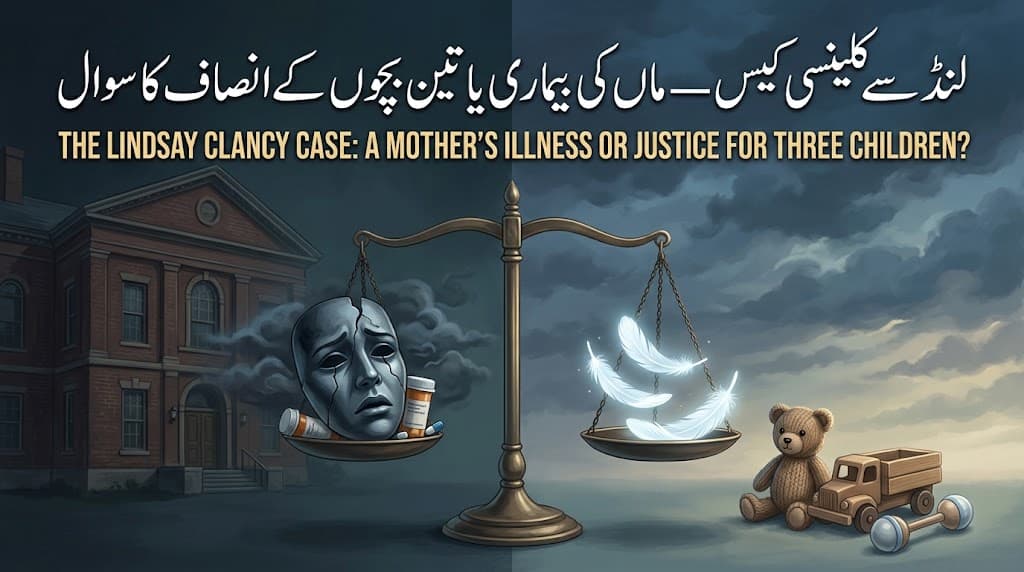
In the United States, the Lindsay Clancy case is no longer just a murder trial against a mother; rather, it has sparked a multi-faceted debate on mental illness, motherhood, women's rights, and children's right to life. The question is not whether a woman suffering from a mental illness deserves empathy or not. She certainly does. The real question is where to draw the line between empathy and justice, especially when the lives of three innocent children are on the other side.
In January 2023, a tragedy occurred in Duxbury, Massachusetts, that shook the entire United States. Lindsay Clancy, a former labor and delivery nurse herself, strangled her three children—five-year-old Cora, three-year-old Dawson, and eight-month-old Callan—to death. Afterward, she attempted to take her own life by jumping from a second-story window, sustaining severe injuries that left her paralyzed from the waist down.
In this trial, there is no dispute over who killed the children. Lindsay Clancy did not deny murdering them. The actual legal battle centered on the question of whether, at the time of the crime, she possessed the mental capacity to understand the nature of her act and its wrongfulness.
Her defense attorneys argued that she was suffering from postpartum psychosis, a rare but extremely severe psychiatric condition that occurs after childbirth. Dr. Phillip Resnick, a psychiatrist presented by the defense, testified in court that at the time of the incident, Clancy was clearly psychotic and lacked normal control over her actions. According to the defense, she was hearing voices commanding her to kill the children.
It is very important to understand one thing here. Postpartum psychosis is not an excuse or just ordinary sadness. It can be a real and dangerous medical condition, characterized by symptoms like hallucinations, delusions, and a break from reality. Therefore, mocking this illness or dismissing it as an excuse invented by women is incorrect. Such mothers require immediate medical attention, supervision, and protection.
However, another picture was also presented in court.
The prosecution argued that while Lindsay Clancy was certainly suffering from severe mental issues, it did not mean she had lost the ability to distinguish between right and wrong. The prosecution highlighted the fact that before murdering the children, she sent her husband out of the house. He went to pick up medication and food for the family, and during this time, all three children were killed. The prosecution cited this as evidence of premeditation and the deliberate creation of an opportunity.
This is exactly the point where, setting aside emotions, the question of law begins.
Does every mental illness eliminate criminal responsibility? Certainly not. And is every psychiatric patient fully responsible for their actions? Not necessarily. This is why courts examine experts, medical records, the sequence of events, and the defendant's state of mind at the time of the crime.
In Lindsay Clancy's trial, even the experts were not unanimous. The defense experts diagnosed her with psychosis, whereas the prosecution's experts maintained that although she suffered from severe mental illness, she still possessed the capacity to understand right and wrong and to control her behavior. This discrepancy ultimately became the biggest question before the jury.
On September 4, 2026, despite weeks of hearings and seven days of deliberations, the jury could not reach a unanimous verdict. Consequently, the judge had to declare a mistrial.
It is crucial to avoid a misconception here. A mistrial does not mean Lindsay Clancy has been proven innocent. It simply means that the current jury was unable to deliver a unanimous verdict. The murder charges against her remain intact, and the prosecution can decide to retry the case.
Around this tragedy, the voices of circles advocating for women's mental health have also grown louder. They argue that postpartum depression and postpartum psychosis have long been denied the importance they deserve by society and the medical system. This point carries weight. A woman is not merely a childbearing machine. Pregnancy, childbirth, hormonal changes, severe sleep deprivation, and psychological stress can deeply impact her physical and mental health. If society demands a mother to be ideal twenty-four hours a day, it must also accept the responsibility for that mother's mental well-being.
But at this very juncture, I want to raise another question.
Who will become the voice of those three children?
Five-year-old Cora is not present in court to defend herself. Three-year-old Dawson cannot tell his story. Eight-month-old Callan probably did not even know the meaning of the word "justice." Despite this, their right to life was no less than that of any adult human being.
The struggle for women's rights is incredibly important in its own right, but the fundamental concept of feminism is justice and equality, not the unconditional defense of every action a woman takes. If a man had murdered his three children while suffering from a mental illness, we would certainly examine his mental state, but we would not push the murdered children to the margins of the debate. This same principle must apply in the case of a woman.
Equality means precisely this: the standard of crime and responsibility should not change based on gender.
At the same time, it is equally important to acknowledge that labeling a woman suffering from postpartum psychosis merely as a "killer mother" and ignoring her illness is not justice either. If credible medical evidence proves that, at the moment of the crime, a person was so disconnected from reality that they had no comprehension of the nature or wrongfulness of their act, the law must take this reality into account. However, this decision should be based on evidence and the law, not on social media slogans, emotional campaigns, or gender politics.
The biggest lesson of the Lindsay Clancy case perhaps lies in prevention, even before punishment.
A woman was continuously going through mental agony. She sought treatment from various doctors, used multiple medications, and even checked into a psychiatric hospital. Despite all this, a few weeks later, three children were dead, and their mother was left with lifelong physical paralysis and entangled in a grave criminal case.
If the illness was truly that severe, the question should not only be, "Should she be punished or not?" The question should also be: Why didn't the medical system recognize the danger in time?
A civilized society does not pit a mother and her children against each other. It tries to save both. A woman suffering from severe postpartum mental illness requires immediate treatment, continuous monitoring, and family support, while the safety of the children must also be given top priority.
There can be empathy for Lindsay Clancy. Her illness must be researched. Potential negligence in her treatment should also be scrutinized. But three graves must not be allowed to go silent amidst the noise of this debate.
Calling mental illness a crime is an injustice, but shutting the door to the legal examination of every crime just by hearing the name of mental illness is not justice either.
The court ultimately has to determine to what extent Lindsay Clancy's mental state at the time of the crime makes her legally responsible. Our job is not to issue a verdict, but to remember a principle:
Justice is complete when both the illness of the accused is considered and the value of the victim's life is recognized.
Cora, Dawson, and Callan can no longer speak.
Therefore, in the debate over justice, their silent voices need to be heard the most.