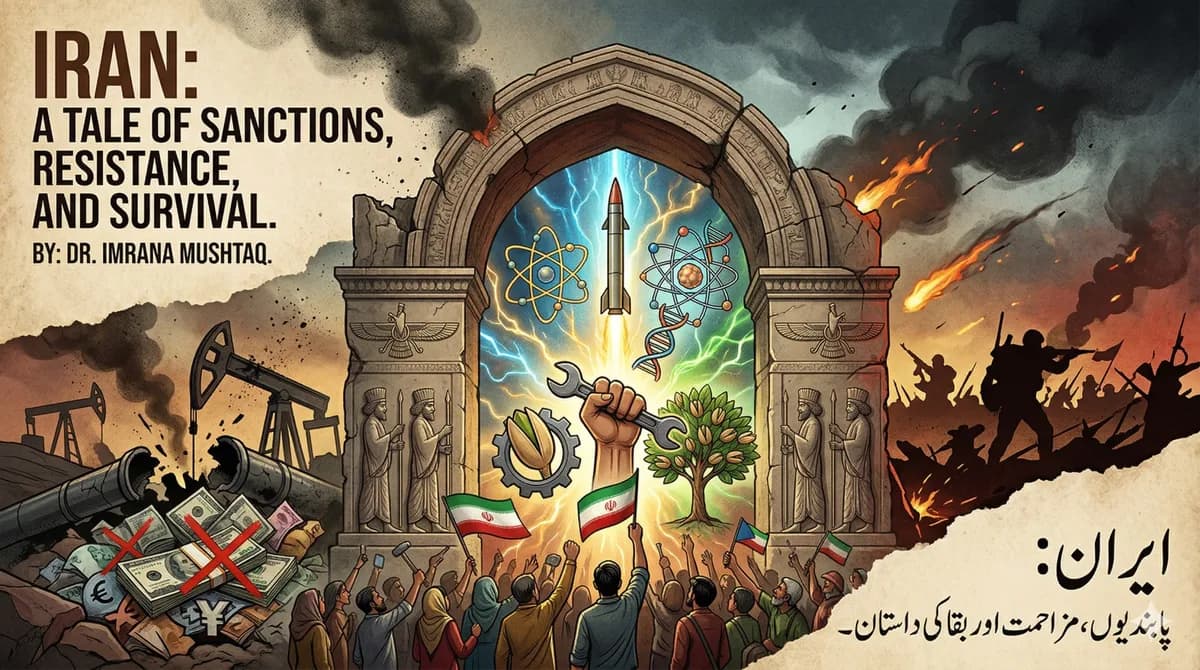
The land of Iran is among those few regions in history where geography, civilization, and politics have become so intertwined that it is impossible to understand them separately. This is a country that laid the foundation of a great civilization thousands of years ago, ruled vast regions of the world, and yet maintained its identity despite the ravages of time, invasions, and internal changes. The history of Iran is fundamentally a tale of continuous struggle—a struggle where survival is linked not merely to power, but to ideology, self-respect, and resistance. That is why today, when we look at Iran in global politics, we see not just a state but a historical consciousness that teaches the lesson of standing firm instead of bowing down in the face of every hardship.
In the ancient era, the Achaemenid Empire introduced Iran as a great power on the global stage. Rulers like Cyrus the Great and Darius established an administrative and political system that was not only unique for its time but is still counted among exemplary models of governance today. This empire was not limited to mere conquests; it also reflected cultural tolerance, religious harmony, and administrative brilliance. This was the era that instilled a strong civilizational confidence within the Iranian nation—a confidence that became a core part of their identity in the centuries to come. Although it was followed by the invasions of Alexander the Great, Arab conquests, and the rise and fall of various empires, Iran's civilizational soul never perished; instead, it survived with renewed vigor in every era.
The advent of Islam introduced a new dimension to Iran's history. The Iranian society did not merely accept Islam but molded it into its own civilizational and intellectual framework. This is why a unique Islamic identity emerged in Iran, which, despite being distinct from the Arab world, remained a part of the broader Islamic sphere. Later, during the Safavid era, the Shia sect was adopted at the state level, which further clarified Iran's religious and political identity. This identity continues to influence Iran's domestic and foreign policies today.
However, the true formation of modern Iran occurred after the Iranian Revolution of 1979. This revolution was not merely a change of government but an ideological rebellion that dismantled the monarchical system and laid the foundation for an Islamic Republic. Public unrest, political oppression, economic inequality, and a backlash against foreign influence were the driving forces behind this revolution. Following the revolution, Iran chose a path that was unacceptable to Western powers, especially the United States, and this was the point where the tension between Iran and the West took a permanent shape.
Immediately after the revolution, Iran faced another major test when the Iran–Iraq War began. This war lasted for eight years and affected Iran in every aspect. Hundreds of thousands of lives were lost, the economy was devastated, and the country faced severe hardships. But this war birthed a spirit of resistance within the Iranian nation that made them even stronger. Iran viewed this war not just as a defensive battle, but as a war for its survival and ideology, and this mindset is still reflected in its political and military behaviors today.
The biggest challenge Iran faced after the war was economic sanctions. The United States and its allies imposed strict sanctions on Iran at various times, aimed at weakening its economy and restricting it within the global system. These sanctions severely impacted Iran's currency, trade, oil exports, and financial system. Ordinary citizens faced issues like inflation, unemployment, and a lack of basic amenities. Despite all these hardships, Iran did not lose hope but adopted an alternative path often referred to as the "Resistance Economy."
Under this resistance economy, Iran promoted its local industries, focused on scientific research, and strove to achieve self-reliance in the defense sector. Today, Iran holds a distinct identity in missile technology, its nuclear program, and various scientific fields. Although its economy is still under pressure, the fact remains that Iran saved itself from total economic collapse.
Iran has also played a unique role in regional politics. To expand its influence in the Middle East, it supported various allies and groups, which it designates as "resistance forces." While this policy made it powerful in the region on one hand, it also subjected it to continuous conflicts and opposition on the other. The United States, Israel, and some Arab countries view Iran as a threat to their interests, whereas Iran presents itself as a force standing against oppression and injustice in the region.
This struggle is not only political or military but also ideological. Iran's stance is that it will not compromise on its sovereignty and principles, no matter how many sacrifices it must make. That is why, despite global pressure, it remains steadfast on its nuclear program and regional policies.
Today's Iran is a complex reality. On one hand, it is facing economic hardships, inflation, and public unrest, while on the other hand, it stands as a strong defensive and political force. Life is not easy for the Iranian people, but there is a sense of national consciousness and self-respect within them that keeps them connected to their country despite the difficulties.
Iran's history teaches us that the true strength of any nation lies not in its resources, but in its ideology and resolve. Wars, sanctions, and pressure may temporarily weaken a country, but if the spirit of resistance is alive in its people, they can confront any challenge. Iran is a living example of this reality—a country that has repeatedly gone through trials but emerged stronger each time.
This story also tells us that in global politics, endurance plays a role just as much as power. Iran has proven that if a nation stands by its principles, it can refuse to bow down even before the greatest powers. This is Iran's true identity, and this is the greatest lesson of its history.