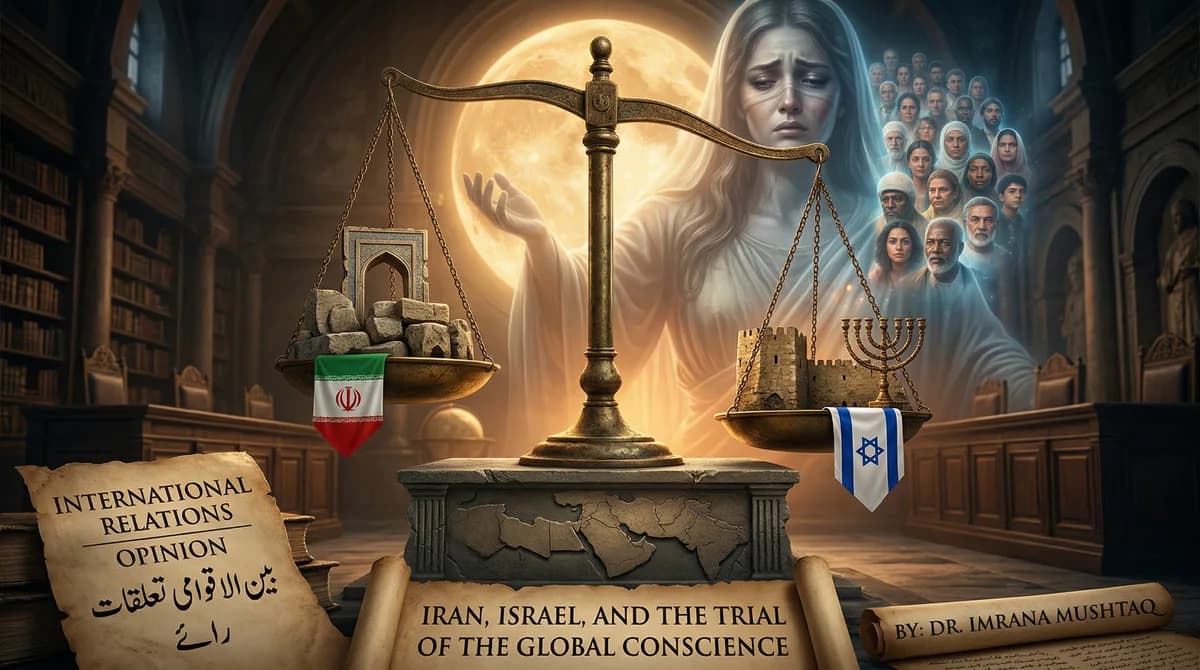
In the shifting global landscape, certain events cease to be mere news and begin to dictate the course of history. The recent tensions between Iran and Israel are among them, putting not only the Middle East but the entire world's politics, economy, and moral values to a new test. This is not merely a conflict between two states but a profound trial of power, justice, resistance, and the global conscience.
The courage, wisdom, and patience with which Iran has navigated this situation are both noteworthy and worth studying. On one hand, it faced continuous provocation; on the other, it dealt with mounting global pressure. Despite this, Iran maintained a clear stance that it reserves the right to self-defense. Conversely, an aggressive continuity is visible in Israel's policies, which has been a primary cause of instability in the region for several decades.
If we examine the situation in Gaza, the atrocities committed there have shaken humanity. Unarmed civilians, innocent children, women, and the elderly have all fallen victim to this war. The international community's silence regarding these atrocities is a massive question mark. In some circles, joy was even expressed over these deaths—a sheer tragedy for human values. Yet, when similar conditions arose within Israel and bodies began returning there, that same society appeared in mourning. This contradiction highlights a bitter truth: pain is only intensely felt when it reaches one's own home; otherwise, the wounds of others are easily ignored.
Iran's response holds significant weight in this broader context. Iran not only announced its right to defense but, according to some reports, issued prior warnings, reflecting the conduct of a responsible state. Even the rules of war have moral boundaries, and Iran attempted to respect these principles, at least to that extent. In stark contrast, allegations have surfaced in the past regarding Israel targeting sensitive sites, educational institutions, mosques, and other civilian installations within Iran, constituting clear violations of international law.
A critical question arises here: has power alone become the ultimate standard for truth? If a powerful state attacks a weaker country or one with limited resources, it is justified as "security," whereas if that same country responds in self-defense, it is condemned as a "threat." This double standard remains the greatest weakness of the global system.
Iran made it clear that if its innocent citizens are targeted, it will not remain silent. This stance is not just state policy; it is a natural human reaction. Any nation will take every possible step to protect its citizens, and that fundamental principle is at work here.
Pakistan's role throughout this crisis has been highly balanced and positive. Pakistan has consistently supported peace, dialogue, and diplomatic solutions. It not only expressed deep concern over the escalating tension but actively participated in ceasefire efforts. In this context, the five points presented jointly with China can be considered a significant breakthrough for global peace. These points emphasize an immediate ceasefire, negotiations between the warring parties, the absolute protection of civilians, and ensuring regional stability.
This initiative is a sign that there are still countries in the world that prioritize peace over raw power. The joint stance of Pakistan and China sends a positive message not only to the region but to the entire world: the solution to these problems lies in dialogue, not war.
Viewing this situation through a wider lens, it becomes evident that the Middle East has once again become the epicenter of global power interests. Every escalation here directly impacts the global economy, particularly oil prices. Consequently, major powers adopt various strategies to maintain their regional influence. However, amidst all these political games, the greatest loss is suffered by the common person—someone who neither desires war nor can afford its devastating consequences.
It is a grim reality that wars are never confined to the battlefield; their toxic effects stretch across generations. A child's youth is stolen, a mother's embrace is left empty, and a society is plunged into fear and insecurity. This is the human cost that is too often overlooked.
What the international community needs most right now is a policy rooted in justice. If the world genuinely desires peace, it must abandon its double standards. There must be one universal rule for every country, regardless of whether they are powerful or weak.
It is equally essential that the media and the intellectual class view this situation impartially and present the unvarnished facts to the public. When information is one-sided, public opinion becomes biased, and this bias only breeds further hatred.
We live in an era of rapid information, where news reaches the far corners of the globe in mere moments. In such times, the responsibility to call the truth the truth, and a lie a lie, increases exponentially.
Amidst this heavy atmosphere, there is still a ray of hope: the enduring desire for peace. The framework presented by Pakistan and China signifies that there are still people and nations willing to champion peace over conflict. If these diplomatic efforts are taken seriously, this crisis could yet take a positive turn.
Ultimately, it must be recognized that this war is not just between Iran and Israel; it is a clash between principle and power. It is a trial in which the entire world must step up and play its part. If we fail to make the right decisions at this crucial juncture, the consequences will be far-reaching and severe.
May reason and wisdom prevail, may the path of negotiation be chosen, and may the world return once again to peace, tranquility, and justice. Because this is the only path that can save humanity, and this is the message that must remain alive in every human heart.