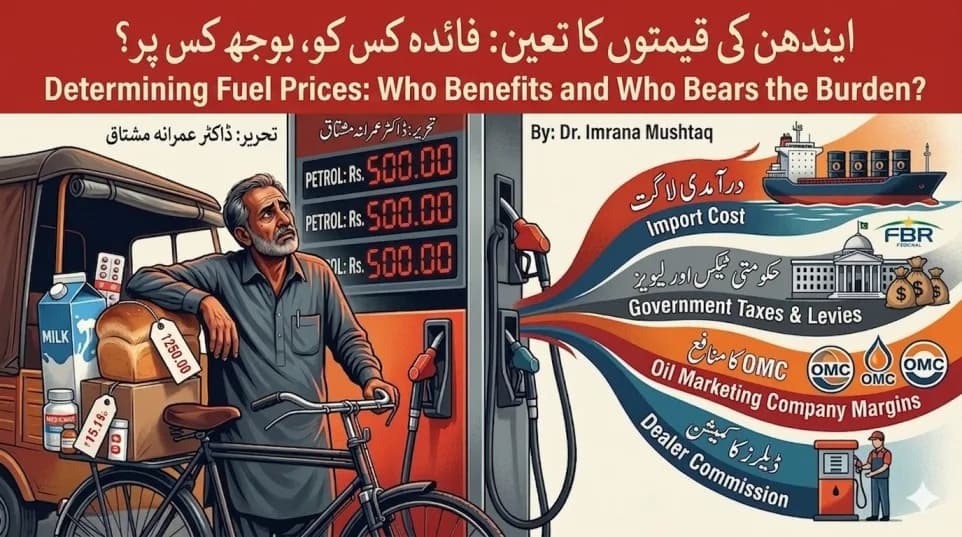
Whenever the prices of petrol, diesel, or other fuels increase in Pakistan, it is the common man who first feels as though their breath is being taken away. Household budgets shatter, transport fares soar, and everything from vegetables, flour, and milk to medicines and daily essentials becomes expensive. Yet, every time, the same question arises: what exactly is the mechanism behind this price determination? Who is reaping the benefits, and who is continuously making sacrifices? This is why various think tanks, economists, business organizations, and trade forums across the country are now seriously considering initiating a constructive national dialogue on this matter to shield the public from further burdens.
In Pakistan, fuel prices are not determined solely by the price of crude oil in the global market; they involve dozens of other factors that the common man remains entirely unaware of. Governments often adopt the stance that prices have surged in the international market, the dollar has appreciated, or global political conditions have deteriorated, making a price hike inevitable. However, on the flip side, the question also arises: when prices drop in the global market, why doesn't the full benefit reach the public?
The largest component of petroleum product prices in Pakistan consists of various taxes and levies. For the Federal Board of Revenue (FBR) and the government, the petroleum sector has become a primary source of income. To bridge the budget deficit, governments frequently increase the petroleum levy and other taxes. Thus, the fuel ostensibly provided to the public actually becomes a tool used to fill the national exchequer.
On the other hand, Oil Marketing Companies (OMCs) are also considered a major force benefiting from this system. These companies ensure their profit margins across all stages—from import and storage to distribution and sales. Critics argue that due to a lack of transparency in price determination, these companies sometimes reap extraordinary benefits, while the public solely bears the brunt of inflation.
In a developing country like Pakistan, where poverty, unemployment, and inflation have already broken the public's back, a hike in fuel prices is no longer just an economic issue; it transforms into a social crisis. For a rickshaw driver, a rise in petrol prices is not just a difference of a few rupees; it becomes a question of his children's milk, school fees, and household groceries. For a white-collar employee, simply fueling a motorcycle becomes a source of immense mental stress.
This is precisely why various economic circles are now pondering whether the current fuel pricing system in Pakistan is genuinely fair. Should the government always take the easy way out and pass the burden onto the public? Shouldn't there be a cap on the profit margins of OMCs? Cannot the burden of taxes be reduced?
Many economists argue that if the government wants to increase its revenue, relying solely on petroleum products is a flawed policy. Broadening the tax net, bringing major sectors into the documented economy, and cutting non-productive expenditures would be far more effective strategies. Unfortunately, making petrol more expensive is considered the easiest method because its burden is immediately absorbed by the public.
Business organizations are also expressing profound concern over this issue. They state that expensive fuel drives up the production costs for industries, makes transportation costly, and consequently makes Pakistani products uncompetitive and expensive in the global market. This negatively impacts exports and puts the national economy under even more pressure.
Some think tanks are now suggesting that the entire petroleum pricing system should undergo an independent audit. The public must be clearly informed about exactly how much of the per-liter price accounts for the actual import cost, how much goes to taxes, what the OMC margins are, and what the dealers' profits constitute. Transparency is the very first step toward restoring trust.
It is also a reality that energy policy in Pakistan often falls prey to short-term political decisions. Sometimes, when elections are near, prices are temporarily frozen, and at other times, massive sudden increases are imposed to meet IMF conditions. This inconsistency causes the greatest harm to both the public and the economy.
Many countries around the world have attempted to find balanced solutions to this problem. In some places, the public is subsidized; in others, there is an automated and transparent pricing system; and in some, a limit is set between the government's and private companies' profits to prevent unnecessary burdens on the people. Pakistan needs to seriously consider adopting such models.
Economic experts state that if the government genuinely wants to provide relief to the masses, it must focus on reducing the petroleum levy, reforming the tax structure, and developing local energy resources. Relying solely on imported oil will always leave the country at the mercy of the global market.
It is also worth noting that fuel price hikes affect not just the urban but also the rural economy. Agricultural machinery, tube wells, transport, and fertilizer logistics all become more expensive. Consequently, the farmer's cost of production rises, making food more expensive. Thus, the ripple effects of a single decision spread throughout the entire economic system.
The need of the hour is to engage in a serious national dialogue on this sensitive issue rather than resorting to emotional slogans. The government, economic experts, business organizations, OMCs, the media, and civil society must all sit at one table to devise a system that not only meets the needs of the national treasury but is also bearable for the public.
It is a welcoming sign that various forums are now moving toward constructive debate. If this dialogue proceeds with honesty and transparency, perhaps a model can emerge that strikes a balance between the interests of the state, businesses, and the public.
Because the ultimate reality is that an economy standing on the shoulders of a weak and exhausted public cannot remain stable for long. If the solution to every crisis is simply to place more burden on the people, inflation will continue to be a cause not only of economic distress but of social unrest as well. And no state can truly be strong as long as its ordinary citizens feel deprived of economic justice.