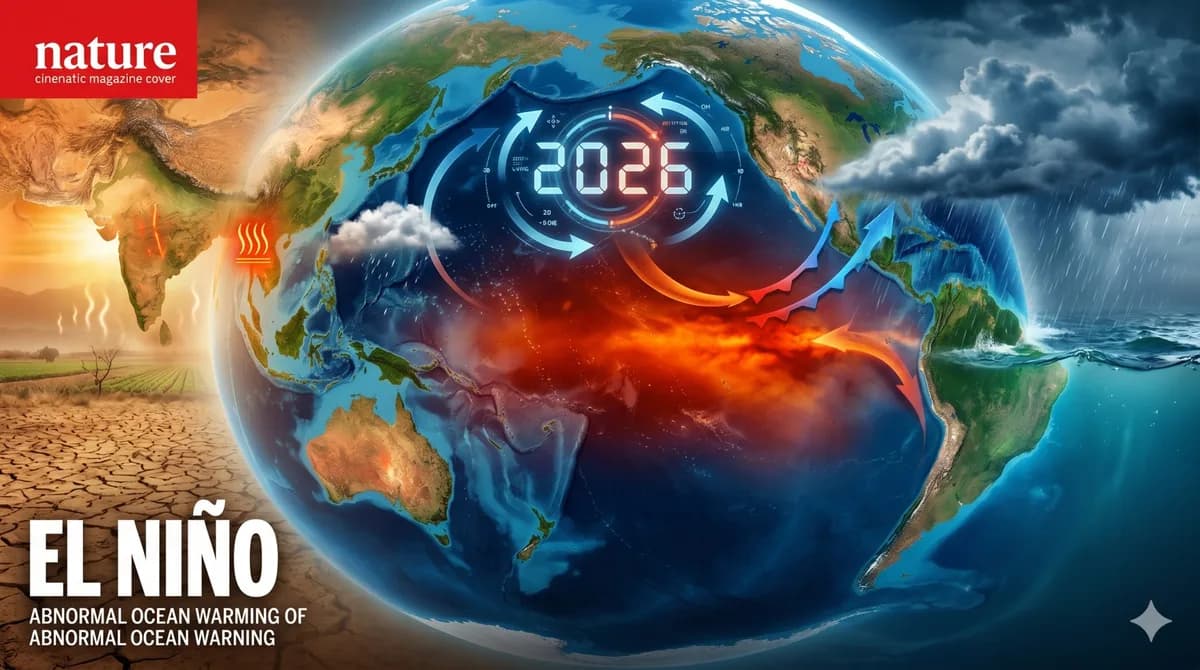
Within the global weather system, there are silent yet powerful phenomena that are seemingly invisible, but their impacts are felt across the entire planet. One such significant phenomenon is "El Niño." Merely hearing its name brings to the minds of meteorologists a complete picture of global temperatures, rainfall patterns, and climatic irregularities. For the general reader, it might just be a scientific term, but the reality is that El Niño affects our daily lives, agriculture, economy, and even politics.
El Niño is essentially the abnormal warming of sea surface temperatures in the central and eastern parts of the Pacific Ocean. This phenomenon occurs every two to seven years and steers the global weather system in a new direction. Under normal conditions, warm water accumulates in the western part of the Pacific (near Australia and Indonesia), while cold water rises to the surface in the eastern part (off the coast of South America). However, when El Niño begins, this balance is disrupted; warm water spreads towards the east, and consequently, weather patterns across the world begin to change.
The impact of El Niño is not restricted to the ocean; it also alters the atmosphere, wind patterns, and rainfall systems. As a result, some regions experience heavy rains and floods, while others fall victim to droughts. Rainfall increases in South America, droughts can occur in Australia and Southeast Asia, while the monsoon system in South Asia is adversely affected.
For an agricultural country like Pakistan, the significance of El Niño becomes even more critical. A major part of its economy relies on agriculture, which in turn depends on rainfall and temperatures. If the monsoon weakens, crops are affected, water shortages emerge, and food prices soar. This is why El Niño is viewed not just as a meteorological phenomenon in Pakistan, but also as a major economic challenge.
The question now arises: what is the expected situation regarding El Niño for the year 2026? Global meteorological organizations and scientists are continuously monitoring sea temperatures and atmospheric systems. In recent years, rapid shifts between El Niño and La Niña have been observed, a major cause of which is climate change. The years 2023 and 2024 witnessed a powerful El Niño that pushed global temperatures to record-breaking levels.
Preliminary estimates for 2026 indicate that the world might enter a relatively moderate phase, known as the "neutral phase"—neither a full El Niño nor a full La Niña. However, experts are warning that the weather system is no longer as stable as it used to be, so unexpected changes can occur at any time. Some models also suggest that signs of El Niño could re-emerge by the end of 2026, although estimating its intensity is difficult at this stage.
For Pakistan, the most critical aspects of the 2026 predictions are the intensity of the monsoon and the temperature. If the effects of El Niño persist, the monsoon could weaken, resulting in less rainfall and an exacerbation of water scarcity. On the other hand, rising temperatures could make heatwaves even more severe, as witnessed over the past few years. This would not only impact human health but also increase the demand for electricity, which is already a significant issue.
The effects of El Niño are not confined to agriculture or weather alone; it also impacts the global economy. When production is affected in various regions, global food prices escalate. Changes in the demand for oil and energy also occur, which affects global markets. For developing nations like Pakistan, this situation becomes even more complicated as they are already under economic pressure.
Another important question here is: are we completely helpless in the face of phenomena like El Niño? The answer is not entirely negative. Although we cannot stop this phenomenon, we can certainly mitigate its effects. For this, better planning, water resource management, the adoption of modern agricultural practices, and climate awareness are highly essential. The government and relevant institutions must take weather forecasts seriously and take timely measures.
Education and awareness can also play a pivotal role in this regard. If farmers are provided with timely information, they can plan their crops more effectively. It is also crucial to raise awareness in urban areas regarding water conservation and energy saving.
Climate change has made phenomena like El Niño even more complex. Previously, it was seen as a natural cycle, but now both its intensity and duration are changing. Due to global warming, ocean temperatures are rising, which can make the effects of El Niño even more severe. Therefore, there is a need to take this issue seriously on a global scale as well.
As a responsible state, Pakistan must not only focus on its internal issues but also participate in global environmental efforts. Climate change is a problem that knows no borders, and its impacts are felt equally across the globe.
In conclusion, it would not be wrong to say that El Niño is not merely a scientific term but a reality silently affecting our lives. The year 2026 could be both a test and an opportunity for us—a test because we have to face changing weather patterns, and an opportunity because we can improve our policies, lifestyles, and mindsets.
If we take timely measures, prioritize scientific research, and awaken our collective consciousness, we can not only mitigate the effects of El Niño but also lay the foundation for a better, safer future. Otherwise, the changing weather will be enough to remind us that ignoring the laws of nature is never a wise choice.