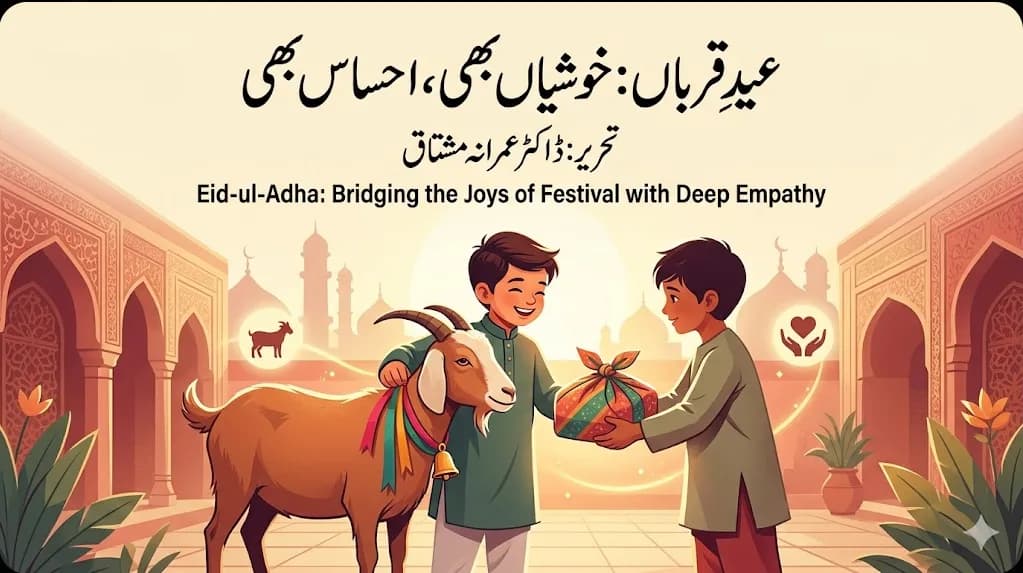
Childhood Eids are perhaps among the most beautiful memories of life. Those days when the sound of goat bells echoed in the courtyard, children joyfully tied colorful ribbons around their necks, mothers were busy in the kitchen, fathers returned from the market with the final shopping, and the whole house was immersed in a strange festive atmosphere. Back then, we probably didn't fully understand the true spirit of sacrifice, but we certainly felt the joy. As time passed, we grew older, circumstances changed, and now we realize that Eid-ul-Adha is not just about new clothes, barbecues, and feasts; it is a festival that teaches sacrifice, love, sharing, and a sense of humanity.
This year, as Eid-ul-Adha approaches, along with the hustle and bustle of the markets, lines of worry are also visible on people's faces. Inflation has broken the back of the common man. Vegetables, meat, flour, sugar, electricity, gas, children's school fees, medicines—everything is moving out of the common man's reach. In such times, celebrating Eid is certainly not easy. In many homes, there are mothers who fall silent after hearing their children's requests. Many fathers return from the markets after just asking the prices. There are countless people who cannot afford to buy a sacrificial animal but surely hold the desire in their hearts.
Under these circumstances, the true message of Eid becomes even more important. Islam has always taught moderation, compassion, and equality. Sacrifice is not just the act of slaughtering an animal; it is also about sacrificing the selfishness, arrogance, and apathy within us. If there is a house near us where the fragrance of Eid has not reached, then our own joy is incomplete.
Sadly, nowadays Eids are also becoming a means of competition and showing off. Videos of expensive animals on social media, goats worth millions, lavish feasts, and a flood of pictures... seeing all this, those who are already fighting the hardships of life feel even more deprived. Celebrating is not a bad thing; if Allah has bestowed blessings, one should be thankful, but the joy should be such that it does not rub salt into anyone's wounds.
The tradition of distributing sacrificial meat is actually meant to keep this very realization alive—that no one in society goes hungry. There are many white-collar (respectable but struggling) families in our neighborhoods who cannot ask for help. Their self-respect keeps them silent. The true beauty of Eid is when we recognize the needs of these silent faces. Quietly leaving meat, rations, or Eidi at someone's doorstep is perhaps the most beautiful act of worship in the eyes of Allah.
It is also a reality that inflation has severely affected not only the poor but also the middle class. The class that used to help others is now living a highly calculated life. In such times, if we bring a little simplicity into our Eid celebrations, perhaps happiness can be shared in many more homes. It is not necessary to have dozens of dishes at every feast, for every dress to be expensive, or for every event to be full of ostentation. Sometimes, a simple dining spread brings hearts closer together.
Eid-ul-Adha reminds us of the great sacrifice of Prophet Ibrahim (AS) and Prophet Ismail (AS). This event is not just history but a message that, for the sake of Allah's pleasure, a person may have to sacrifice even their most beloved thing. Today, if we sacrifice a portion of our comfort, our extravagance, our ego, and our apathy, perhaps society will begin to change.
Given the circumstances Pakistan is currently going through, there is a dire need for national unity and social compassion. Inflation, unemployment, mental stress, and despair have exhausted people from the inside. In such times, Eids can become a ray of hope. A phone call, an invitation, a plate of meat, some Eidi, or a smile... can become a lifeline for someone.
We must also remember that Eid is not just a test for humans, but also of the environment, cleanliness, and civic responsibilities. Throwing animal waste on the streets after the sacrifice, leaving the alleys dirty, or adopting an inhumane attitude towards the sanitation staff is against our religious and social teachings. Islam declares cleanliness as half of faith. If we truly want to understand the spirit of Eid, we must also take care of cleanliness, discipline, and the comfort of others.
There is also a need to teach children the true spirit of Eid. Not just about new clothes and food, but the spirit of sharing, love for animals, caring for the poor, and gratitude—these are all the lessons that Eid teaches us. If the new generation only learns to show off, empathy in society will gradually diminish.
Today, wars, hunger, poverty, and uncertainty are increasing around the world. Palestine, Kashmir, and many regions of the world are going through human suffering. In such times, the aspect of prayer should also be included in our Eid joys. We should pray not only for ourselves but for peace, ease, and mercy for all of humanity.
The true beauty of Eid-ul-Adha is that happiness is not celebrated alone. This joy includes relatives, neighbors, the poor, and all those people without whom society is incomplete. If we make just one decision this Eid—to bring smiles to the faces of others along with our own joy—then perhaps this will capture the true spirit of sacrifice.
Let us not just decorate our dining spreads this Eid, but also illuminate our hearts. Eat, drink, celebrate, laugh with children, maintain relationships, but do not forget those who are silently bearing the burden of circumstances. Because Eid is only complete when happiness reaches everyone.