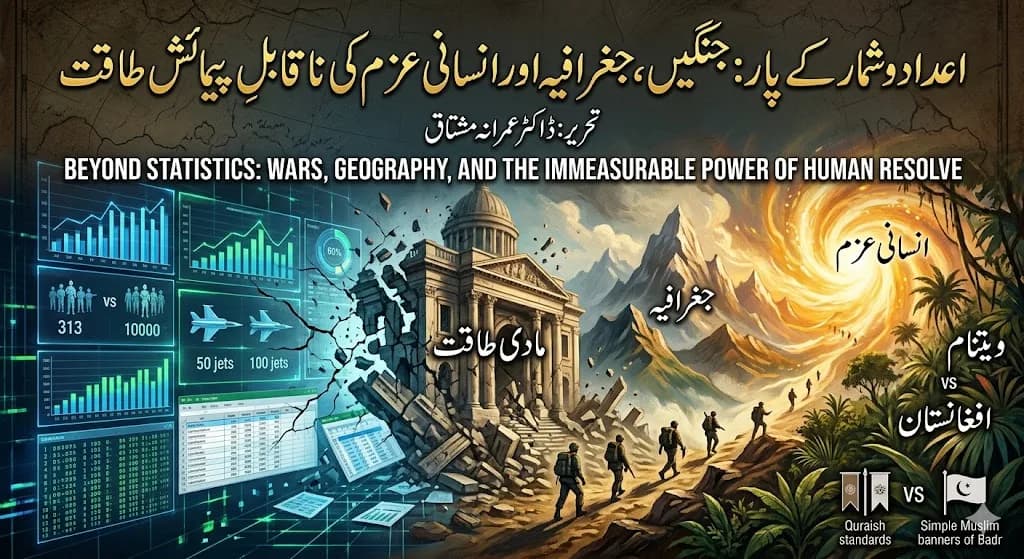
If the modern world is described as a world of statistics, charts, and presentations, it might not be an exaggeration. Today, from governments to international organizations, and from corporate entities to military planners, there is a growing trend to base every decision purely on data, graphs, and statistics. On the surface, this appears to be a highly scientific and logical approach, but history has repeatedly proven that considering only measurable things as important can be a massive intellectual error. The world knows this error as the "McNamara Fallacy."
US Secretary of Defense Robert McNamara believed that if all measurable aspects of a problem were accurately analyzed, the correct outcome could be achieved. During the Vietnam War, American policymakers thoroughly reviewed troop numbers, fighter jets, tanks, ammunition, economic resources, and military capabilities. All statistics indicated that America would easily defeat a weak and relatively backward country like Vietnam. However, history delivered a different verdict. After an eight-year war, the United States had to retreat, and the world's greatest superpower failed to achieve its objectives against a small nation.
A major reason for this failure was that American analysts ignored the factors that do not appear on a chart or a spreadsheet. They counted weapons, but could not measure the spirit of freedom. They counted the number of soldiers, but could not quantify national honor and the spirit of sacrifice. They calculated military strength, but completely forgot the power of human resolve.
This is not just the story of Vietnam. The history of Afghanistan is also a testament to this reality. The Soviet Union stepped into Afghanistan relying on its immense military might, assuming the situation would fall completely under its control within a few years. Yet, after a ten-year war, it was forced to retreat. Later, the US and NATO forces also remained in Afghanistan for twenty years, utilizing the most advanced technology and limitless resources, but they too failed to achieve the outcomes they had meticulously planned for.
The Decisive Role of Geography
In all these debates, another crucial element is often ignored: Geography. As a student of political geography, I have always emphasized the reality that wars are not won by weapons and troop numbers alone. Terrain, location, weather, mountains, rivers, sea routes, borders, and neighboring countries all leave a profound impact on the final outcome.
-
The dense forests and complex terrain of Vietnam created countless difficulties for the US military.
-
The towering mountains and treacherous paths of Afghanistan remained a constant headache for two global superpowers.
If geography were truly unimportant, the world's greatest military powers would not have been entangled in such prolonged wars without achieving their goals.
Similarly, a country's neighbors heavily influence the outcomes of a conflict. At first glance, if one country possesses a hundred fighter jets and another has only fifty, it might seem inevitable that victory belongs to the first. But if the second country has the political, diplomatic, economic, or logistical backing of its neighbors, the balance of power can shift entirely. Wars are fought not just on battlefronts, but through supply lines, borders, alliances, and regional relations.
The Unseen Forces of Victory
Today, whether looking at the situation in the Middle East or other global conflicts, drawing final conclusions by merely looking at military statistics is unwise. Many unseen factors prove decisive in practice. These include:
-
Ideological affiliation
-
National identity
-
Religious faith
-
Historical consciousness
-
Trust in leadership
-
The spirit of sacrifice
A magnificent chapter of Muslim history sits right before us as a prime example. In the Battle of Badr, the army of the Quraish of Mecca numbered around one thousand, while the Muslims numbered only three hundred and thirteen. There was a stark contrast between the two factions regarding resources, horses, camels, and military equipment. If a modern data analyst had compared the two armies before this battle, it is highly likely they would have predicted a crushing defeat for the Muslims.
But history proved that the power of human resolve and faith sometimes overcomes all material calculations. The Muslims lacked numbers, but their purpose was grand. Their resources were limited, but their conviction was absolute. Their outward strength was minimal, but their inner power was unparalleled. This was the exact element that could never be captured in any table or chart.
Finding the Balance
This absolutely does not mean we should deny the importance of research, statistics, and scientific analysis. In the modern world, data is indispensable for planning and policymaking. The real problem arises when we start believing that only what can be measured holds value. The reality is that many fundamental elements of human existence are entirely immeasurable.
Factors like love, fear, hope, loyalty, honor, sacrifice, faith, resolve, and national consciousness cannot be fully quantified on any scale—yet these are the very factors that change the destinies of nations. These are the forces that enable supposedly "weak" individuals and nations to perform extraordinary feats.
Unfortunately, in our society today, the trend of reducing everything to presentations, PowerPoint slides, and statistical reports is growing rapidly. It feels as though a few graphs and charts can explain the entirety of a situation, even though reality is far more complex and multidimensional.
A great leader, a successful general, a wise teacher, and an effective policymaker is one who understands human psychology, geography, history, culture, and ideological motivations just as well as they understand statistics. They know that graphs and charts only show a fraction of the picture, never the whole.
The ultimate lesson of history is that nations relying solely on material strength frequently face astonishing failures. Conversely, nations that understand ideological strength, collective resolve, geographical realities, and human emotions alongside their material resources manage to achieve what seems impossible.
We must definitely benefit from research and statistics, but we must not treat them as the absolute, unquestionable truth. When making decisions, we must account for those invisible factors that are, in reality, the most powerful. A human is not just a number; they are an emotion. Nations are not just a collection of statistics; they are a manifestation of ideologies, dreams, sacrifices, geography, and collective willpower.
Perhaps this is the very reality McNamara could not grasp, and which history repeatedly demonstrates to us in varying forms. Statistics are important, but reality is far greater than them.