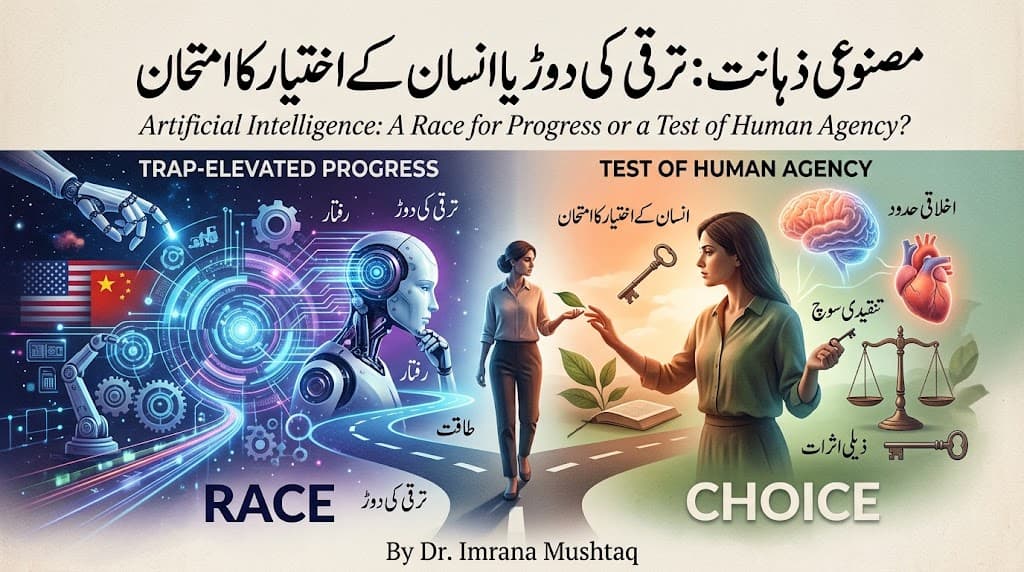
Are we shaping artificial intelligence, or has artificial intelligence gradually begun reshaping our world, our priorities, our decisions, and our way of thinking? This question is no longer confined to science fiction, speculative tales of the future, or mere philosophical musings. AI has become a living reality of our daily life, quietly expanding its sphere around us. Whether it is education or medicine, journalism or research, commerce or industry, public administration or defense, creative literature or everyday dialogue, artificial intelligence is no longer merely a machine; it is becoming an active collaborator in almost every sphere of human endeavor.
Humans have always fashioned tools: we crafted the wheel, built the steam engine, harnessed electricity, invented the computer, and interconnected the entire globe through the internet. Yet AI is fundamentally distinct because, for the first time, humanity has created a tool that does not merely move at its command, but comprehends language, answers questions, generates images, writes computer code, synthesizes complex data, and, under certain conditions, executes multi-stage tasks in a relatively autonomous fashion. Right here, alongside wonder, deep unease is born. The central issue is not how rapidly artificial intelligence is evolving, but whether human society is keeping pace in comprehending its repercussions, evaluating its risks, and establishing ethical and legal boundaries.
In recent times, this concern has not been limited to AI critics alone. Even prominent figures and researchers within the industry have highlighted that this breakneck race of capabilities might be outpacing safety preparations. Experts affiliated with major corporations developing powerful AI systems continue to emphasize the necessity of safety evaluations, external oversight, and societal preparedness. This is no trivial debate. When individuals at the very epicenter of developing this technology speak of the imperative balance between velocity and safety, it becomes essential for the world to take heed.
The predicament is that artificial intelligence is no longer merely science; it has transformed into geopolitical power. In the twentieth century, the world witnessed the space race between the United States and the Soviet Union. In the twenty-first century, a new technological rivalry is emerging, with two primary epicenters: the United States and China. AI has become deeply intertwined with national economies, defense apparatuses, scientific research, cyber capabilities, industry, and global influence. No major power is willing to risk exercising unilateral caution only to find its adversary leaping ahead technologically. If one nation decelerates its AI development to allow safety research to mature, it harbors the fear that its rival will exploit the lull to secure technological supremacy. The rival is captive to the exact same anxiety. Consequently, rather than slowing down, both feel compelled to accelerate. At this juncture, the AI dilemma steps out of laboratories and enters the corridors of global politics, economics, and international security.
A pivotal dimension of this entire issue is that the danger does not reside within the machine alone; it is concealed within humanity itself. Artificial intelligence possesses no moral conscience, cultural sensibility, or lived human experience of its own. Humans build it, humans train it, and humans deploy it for divergent ends. If leveraged for cancer diagnostics, discovering novel pharmaceuticals, studying climate change, assisting individuals with disabilities, broadening educational access, and advancing scientific breakthroughs, this technology can prove to be an extraordinary blessing for mankind. Conversely, if the same capability is harnessed for deception, cybercrime, disinformation campaigns, inciting hatred, surveillance, fraud, and warfare, this blessing can mutate into a grave catastrophe. Perhaps before attempting to instill ethics into machines, humanity must hold its own ethics to account, for the machine ultimately becomes a mirror of the civilization whose hands fashioned it.
Discounting the profound benefits of artificial intelligence would be unjust. In medicine, while it may not replace the physician, it serves as an exceptional diagnostic assistant. In research, it can sift through decades of academic material in mere moments. In the hands of an educator, it can provide customized instructional support tailored to students of differing cognitive aptitudes. In business, it can dissect intricate data matrices. In public institutions, it can aid in enhancing civic services, flagging financial irregularities, and augmenting decision-making processes. Governments can harness it to analyze vast swathes of data to formulate more effective public policy. Gateways to human knowledge that once demanded lifetimes of labor can now swing open swiftly. The upside is unquestionably immense, but the concomitant responsibility scales in equal measure.
The initial seismic shock of this transition is likely to be felt in employment. Every industrial revolution has extinguished certain vocations while birthing new ones. Artificial intelligence will follow suit, yet this time the velocity of disruption could prove unprecedented. The pivotal question is not merely how many jobs will be displaced, but how many human beings can acquire new competencies in time. If technology transforms in a matter of years while educational systems crawl at a pace decades old, economic inequality will inevitably widen. In developing societies, where legions of young people are already struggling to secure dignified livelihoods, this predicament could become exceptionally dire. Governments and educational institutions must confront today the challenge of imparting to the rising generation not just degrees, but enduring capabilities that keep them gainfully and honorably employable within a shifting economic landscape.
Another grave hazard is the blurring boundary between reality and fabrications. We have crossed into an epoch where an individual's voice can be cloned, their visage seamlessly altered, videos manufactured showing actions they never performed, and news articles drafted that appear impeccably authentic at first glance. Artificially generated deepfakes and synthetic media are no longer harmless entertainment; they can be weaponized for character assassination, financial fraud, disinformation, and social chaos. The citizen of tomorrow cannot remain satisfied simply knowing where a story was published; they must determine its original provenance, how the content was synthesized, and who independently corroborated it. An age in which even what the eye sees is not necessarily real represents an unprecedented trial for the entire edifice of human trust.
An even quieter, more insidious peril is the abdication of our own intellect. If we outsource every letter to artificial intelligence, rely on it for every book summary, seek solutions to every dilemma from it, surrender every creative spark to its algorithms, and turn to machines for every judgment, we risk atrophying our own critical thinking in the pursuit of convenience. An AI-generated response may appear remarkably self-assured, yet it can be fundamentally mistaken. If humanity abandons its critical discernment, an erroneous algorithmic answer can compromise momentous decisions. Artificial intelligence ought to be an amplifier of human intellect, not its replacement. Glancing through a synopsis instead of reading a book is undeniably facile, but the intellectual depth nurtured by deep reading cannot be harvested from a terse summary. A machine may facilitate the creative process, but it can never substitute for human experience, pain, love, keen observation, memory, and raw emotional depth.
The concentration of power represents another serious concern. If the most capable AI systems of tomorrow are monopolized by a handful of corporate conglomerates, sovereign states, or elite institutions, the dilemma transcends technology—it becomes a question of agency and control. Who holds the data? Who architects the architecture? Who defines the normative rules of decision-making? Who is held liable when algorithmic decisions misfire? And how can an ordinary citizen decipher the criteria upon which judgments about their life were made? This inquiry cuts to the core of democracy, human liberty, personal privacy, and civil rights. The more potent the technology, the more imperative the accountability of those who wield it.
The arenas of warfare and cybersecurity render this issue even more precarious. While artificial intelligence can fortify cyber defenses, it simultaneously amplifies the capabilities of attackers. While it can enhance surveillance systems, it can also emerge as a menace to civil liberties. While it can aid strategic defense planning, it births profound ethical and legal quandaries concerning autonomous lethal weapons systems that humanity has never confronted with such immediacy. If machines are accorded a larger role in life-and-death determinations, where does the ultimate line of accountability fall? This is why AI safety has ceased to be an academic concern of computer science, transforming into a matter of national and global security. Nevertheless, alarmism must not substitute for rational discourse. Experts remain divided on the probability and proximity of apocalyptic scenarios; this divergence underscores that policy decisions must be anchored in empirical evidence and ongoing research rather than hyperbole or complacency.
Ultimately, the fundamental question is one of ethics. We inhabit an economic order where success is predominantly benchmarked by capital, speed, acclaim, market hegemony, and immediate returns. If the evolution of artificial intelligence is evaluated solely through this metric, the governing question will merely be: What can we build before our competitor does? Yet human society ought to be asking: Is that which we have the capability to create also ethical to deploy immediately? Technical capability and moral justification are not synonymous. History repeatedly demonstrates that humanity's technological prowess can outstrip its moral maturity. When humans split the atom, the question immediately arose whether that power would illuminate cities or reduce them to ash. As genetic science surged forward, questions regarding the limits of therapeutic intervention versus altering the human template emerged. Artificial intelligence presents this perennial question in a new, immensely more complex guise: once supreme power is acquired, who defines the boundary of its exercise?
Halting artificial intelligence entirely is neither pragmatic nor sensible. The opposite extreme—unleashing every emergent capability onto the world simply because we possess the skill to create it—is equally perilous. The righteous path lies in responsible development. Safety research, rigorous evaluation, and institutional oversight must advance at the same tempo as the expansion of AI capabilities. Prior to deploying an immensely powerful system at scale, it is insufficient merely to understand what it can achieve; one must thoroughly evaluate the catastrophic harm it could inflict through malfunction or malicious abuse. Innovation and safety are not antagonists; they are indispensable complements.
A commercial entity developing artificial intelligence cannot be the sole arbiter of its own creations. Independent experts and safety auditors must be granted access—within appropriate legal and technical parameters—to rigorously stress-test cutting-edge systems. If independent certification is deemed mandatory for pharmaceuticals, aviation, civil construction, and major industrial endeavors, there is no justification for exempting algorithmic systems that sway the information intake and critical choices of millions. Transparency fosters public trust, whereas unchecked self-regulation invites systemic conflicts of interest.
In the global AI arena, the United States and China stand as the twin preeminent powers, and their rivalry for technological supremacy will likely intensify in the coming years. Eradicating this competition altogether may be unrealistic, but containing it before the race for speed eclipses human safety is paramount. Open communication channels and baseline agreements between the two nations regarding AI safety, cyber risks, autonomous weapons, disinformation, and the catastrophic risks of frontier models are imperative. History illustrates that even in moments of severe ideological and military rivalry, superpowers can negotiate over shared existential perils. During the Cold War, adversary states instituted communication hotlines and bilateral protocols designed to avert miscalculation and accidental escalation. The AI era demands precisely this caliber of foresight. This technology knows no geographical borders. A cyber threat conceived in one country, a cascade of synthetic disinformation, or an uncontrollable autonomous system will reverberate across borders. The US-China rivalry must not simply be a zero-sum sprint to the finish line; it must incorporate the sobering realization that certain hazards are collective, where the defeat of one is not the triumph of the other, but the common ruin of humanity.
It is equally inappropriate to treat every application of artificial intelligence with a broad brush. Educational platforms, diagnostic assistive tools, and creative aids occupy an entirely different tier of risk than autonomous lethal weapons, deep-tier biological engineering models, or mass cyber-offensive frameworks. Regulatory statutes must therefore be tiered according to the severity of risk. Burdening low-risk, innovative applications with suffocating red tape stifles positive progress, while leaving highly sensitive capabilities unregulated endangers human civilization.
It is likewise imperative that human values and safety principles serve as foundational guardrails in training AI models. Not every trait of humanity is worthy of emulation. Human societies harbor hate, prejudice, violence, deceit, and exploitation; this does not mean machines should internalize these flaws as normative human behavior. Continual refinement in training methodologies, alignment protocols, and human-in-the-loop oversight is required to diminish toxic manifestations. The machine must learn from the vast tapestry of human knowledge, but it must not mirror humanity's basest frailties.
Education holds an indispensable role in this civilizational shift. It is not enough to instruct the upcoming generation on how to prompt an AI; it is vastly more critical to teach them how to interrogate the answers it provides. A student must recognize that a machine can hallucinate or deceive. Not every aesthetically pleasing image represents reality; not every viral clip constitutes evidence; not every articulate, confident reply is factually sound. Finding primary citations, cross-referencing disparate sources, scrutinizing premises, and safeguarding independent critical thought must form the baseline literacy of the modern century. The generation entrusted with AI must learn not to be awestruck by algorithmic intellect, but to keep their own discernment and intellect vibrantly awake.
Perhaps the most profound issue remains human agency. We must never build a civilization in which human actors exonerate themselves of responsibility by declaring: “The computer made the decision.” In arenas such as the judiciary, healthcare, pedagogy, employment, civil liberties, and warfare, ultimate moral accountability must rest inviolably with human beings and human institutions. Delegating tasks to machines while retaining moral ownership is daunting, yet it stands as the defining trial of our epoch.
Artificial intelligence can undoubtedly emerge as one of the greatest technological opportunities in human history. It can accelerate cures for incurable diseases, democratize access to knowledge, dismantle barriers for people with disabilities, supercharge human productivity, and unlock scientific breakthroughs that currently lie beyond our grasp. Yet every monumental opportunity casts a long shadow. If we reduce AI to a reckless pursuit of wealth, raw power will balloon while wisdom recedes. If we confine it to a battleground for American and Chinese supremacy, speed will eclipse safety. If we allow it to replace human cognition rather than enrich it, we will trade our foundational intellectual faculties for fleeting convenience. And if we assume that technology will automatically resolve the very crises it creates, we will be guilty of an unpardonable abdication of human responsibility.
Artificial intelligence must remain the tool of humanity, never its master. To safeguard this relationship, regulation must match innovation, caution must accompany velocity, accountability must balance power, oversight must complement autonomy, and ethics must guide intellect. The world need not yield to irrational paralysis, yet neither can it afford to be so dazzled by the brilliance of the machine that it blinds its own inner vision. Future generations will perhaps not ask how intelligent the machines of our time were; they will scrutinize what humanity did when gifted with unprecedented power. Did we shape it into a lamp of enlightenment, or a weapon of deception? Did we empower the human spirit, or surrender our agency to an algorithm? Did we abandon ourselves to the frenzy of the race, or steadfastly uphold moral responsibility?
The ultimate test of artificial intelligence is not the brilliance of the machine, but the moral insight of humanity. History will likely not record how ingenious an artifact we engineered; it will chronicle how conscious human beings remained in the presence of that creation. We have fashioned with our own hands a force capable of expanding our knowledge, or amplifying our shortcomings tenfold. The decision does not belong to the machine. The decision belongs to us: whether we nurture it as a guiding lantern, or kindle a blaze in whose heat we consume our own human agency.
Ultimately, the question is not how far artificial intelligence can outpace humanity. The true question is: How long can humanity keep the lamp of its conscience, its intellect, and its agency burning brightly before the creations of its own hands?